
A story of getting the View layer up and running quickly in Spring…
Since the original article, parts of the code has been accepted upstream, now available as part of the Tiles-3 release, so the article has been updated — it's all even simpler!
a web application's view layer
with four simple steps using Spring and Tiles-3
to make organising large complex websites elegant with minimal of xml editing.

Contents of article… • Background • Step 0: Spring to Tiles Integration • Step 1: Wildcards • Step 2: The fallback pattern • Step 3: Definition includes • When the Composite pattern is superior • Conclusion
Background
- from a design perspective the Decorator pattern can undermine the seperation MVC intends,
- requires all possible html for a request in buffer requiring large amounts of memory
- unable to flush the response before the response is complete,
- requires more overall processing due to all the potentially included fragments,
- does not guaranteed thread safety, and
- does not provide any structure or organisation amongst jsps, making refactorings and other tricks awkward.
One of the alternatives we looked at was Apache Tiles. It follows the Composite Pattern, but within that allows one to take advantage of the Decorator pattern using a ViewPreparer. This meant it provided by default what we considered a superior design but if necessary could also do what SiteMesh was good at. It already had integration with Spring, and the way it worked it meant that once the Spring-Web controller code was executed, the Spring’s view resolver would pass the model onto Tiles letting it do the rest. This gave us a clear MVC separation and an encapsulation ensuring single thread safety within the view domain.
“Tiles has been indeed the most undervalued project in past decade. It was the most useful part of struts, but when the focus shifted away from struts, tiles was forgotten. Since then struts as been outpaced by spring and JSF, however tiles is still the easiest and most elegant way to organize a complex web site, and it works not only with struts, but with every current MVC technology.” – Nicolas Le Bas
Yet the best Tiles was going to give wasn’t realised until we started experimenting a little more…
Step 0: Spring to Tiles Integration
The first step is integrating Tiles and Spring together. For Tiles-3 it boils down to registering a ViewResolver and a TilesConfigurer in your spring-web configuration.
<bean id="viewResolver" class="org.springframework.web.servlet.view.tiles3.TilesViewResolver"/>
<bean id="tilesConfigurer" class="org.springframework.web.servlet.view.tiles3.TilesConfigurer">
<property name="tilesInitializer">
<bean class="no.finntech.control.servlet.tiles.FinnTilesInitialiser"/>
</property>
</bean> public class FinnTilesInitialiser extends AbstractTilesInitializer {
public FinnTilesInitialiser() {}
@Override
protected AbstractTilesContainerFactory createContainerFactory(TilesApplicationContext context) {
return new FinnTilesContainerFactory();
}
}Step 1: Wildcards
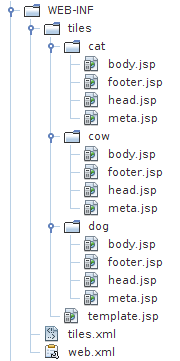
Let's declare a definition and template as below and create some files and folders as shown to the right:
//--tiles.xml
//--  anything that doesn't start with a slash is considered a definition here.
<definition name="REGEXP:([^/].*)" template="/WEB-INF/tiles/template.jsp">
  <put-attribute name="meta" value="/WEB-INF/tiles/{1}/meta.jsp"/>
  <put-attribute name="header" value="/WEB-INF/tiles/{1}/header.jsp"/>
  <put-attribute name="body" value="/WEB-INF/tiles/{1}/body.jsp"/>
  <put-attribute name="footer" value="/WEB-INF/tiles/{1}/footer.jsp"/>
</definition>
//--template.jsp
<!DOCTYPE html>
<%@ prefix="tiles" taglib uri="http://tiles.apache.org/tags-tiles" %>
<html>
<head>
<tiles:insertAttribute name="meta"/>
</head>
<body>
<div id="header"><tiles:insertAttribute name="header"/></div>
<div id="body"><tiles:insertAttribute name="body"/></div>
<div id="footer"><tiles:insertAttribute name="footer"/></div>
</body>
</html>@Controller
public class MyWebsite{
@RequestMapping("/cat")
public ModelAndView viewCat(){
Map modelMap = new HashMap();
//...
return new ModelAndView("cat", modelMap);
}
@RequestMapping("/dog")
public ModelAndView viewDog(){
Map modelMap = new HashMap();
//...
return new ModelAndView("dog", modelMap);
}
@RequestMapping("/cow")
public ModelAndView viewCow(){
Map modelMap = new HashMap();
//...
return new ModelAndView("cow", modelMap);
}
}The Apache Tiles tutorial on wildcards explains that to extend the use of wildcards to also allow rich regular expressions one should use the
CompleteAutoloadTilesContainerFactory. In this article we are building up our own FinnTilesInitialiser and FinnTilesContainerFactory configuration classes. To enable both wilcards and regular expressions, distinguished by the use of prefixes, we need to override the following method in FinnTilesContainerFactory…
@Override
protected <T> PatternDefinitionResolver<T> createPatternDefinitionResolver(Class<T> cls) {
PrefixedPatternDefinitionResolver<T> r = new PrefixedPatternDefinitionResolver<T>();
r.registerDefinitionPatternMatcherFactory(
"WILDCARD", new WildcardDefinitionPatternMatcherFactory());
r.registerDefinitionPatternMatcherFactory(
"REGEXP", new RegexpDefinitionPatternMatcherFactory());
return r;
} Troubleshooting: remember to include the tiles-extras dependency! Without it you'll get
 ...CompatibilityDigesterDefinitionsReader cannot be cast to ...DefinitionStep 2: The fallback pattern
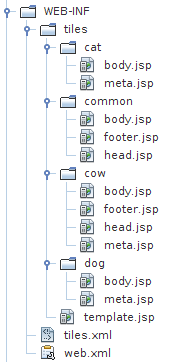
${options[myopts]} where "myopts" is a list-attribute that references the options in preferential order.
Introduce the "common" folder, as shown to the right, and the example turns into
//--tiles.xml
<definition name="REGEXP:([^/].*" template="/WEB-INF/tiles/template.jsp">
    <put-attribute name="meta" value="/WEB-INF/tiles/${options[myopts]}/meta.jsp"/>
    <put-attribute name="header" value="/WEB-INF/tiles/${options[myopts]}/header.jsp"/>
    <put-attribute name="body" value="/WEB-INF/tiles/${options[myopts]}/body.jsp"/>
    <put-attribute name="footer" value="/WEB-INF/tiles/${options[myopts]}/footer.jsp"/>


    <put-list-attribute name="myopts" cascade="true">
        <add-attribute value="{1}"/>
        <add-attribute value="common"/>
    </put-list-attribute>
</definition>OptionsRenderer to work in your TilesContainerFactory you'll also need to do the following
public class FinnTilesContainerFactory extends BasicTilesContainerFactory {
    ...
    @Override
    protected Renderer createTemplateAttributeRenderer(BasicRendererFactory rendererFactory, ApplicationContext applicationContext, TilesContainer container, AttributeEvaluatorFactory attributeEvaluatorFactory) {

        Renderer original = super.createTemplateAttributeRenderer(rendererFactory, applicationContext, container, attributeEvaluatorFactory);
        OptionsRenderer optionsRenderer = new OptionsRenderer(applicationContext, original);
        return optionsRenderer;
    }
    ....
}No more xml editing and no duplicate JSPs.
Step 3: Definition includes
    @Controller
    @RequestMapping("/cat")
    public class CatController{
        @RequestMapping("/cat/view")
        public ModelAndView viewCat(){ //...
            return new ModelAndView("view.cat", modelMap);
        }
        @RequestMapping("/cat/edit")
        public ModelAndView editCat(){ //...
            return new ModelAndView("edit.cat", modelMap);
        }
        @RequestMapping("/cat/search")
        public ModelAndView searchCat(){ //...
            return new ModelAndView("search.cat", modelMap);
        }
    }
    @Controller
    @RequestMapping("/dog")
    public class DogController{
        @RequestMapping("/dog/view")
        public ModelAndView viewDog(){/ /...
            return new ModelAndView("view.dog", modelMap);
        }
        @RequestMapping("/dog/edit")
        public ModelAndView editDog(){ //...
            return new ModelAndView("edit.dog", modelMap);
        }
        @RequestMapping("/dog/search")
        public ModelAndView searchDog(){ //...
            return new ModelAndView("search.dog", modelMap);
        }
    }
    @Controller
    @RequestMapping("/cow")
    public class CowController{
        @RequestMapping("/cow/view")
        public ModelAndView viewCow(){ //...
            return new ModelAndView("view.cow", modelMap);
        }
        @RequestMapping("/cow/edit")
        public ModelAndView editCow(){ //...
            return new ModelAndView("edit.cow", modelMap);
        }
        @RequestMapping("/cow/search")
        public ModelAndView searchCow(){ //...
            return new ModelAndView("search.cow", modelMap);
        }
}//-- tiles.xml
<definition name="REGEXP:([^/.][^.]*)\.([^.]+)" template="/WEB-INF/tiles/template.jsp">
<put-attribute name="meta" value="/WEB-INF/tiles/${options[myopts]}/meta.jsp"/>
<put-attribute name="header" value="/WEB-INF/tiles/${options[myopts]}/header.jsp"/>
<put-attribute name="body" value="/WEB-INF/tiles/${options[myopts]}/body.jsp"/>
<put-attribute name="footer" value="/WEB-INF/tiles/${options[myopts]}/footer.jsp"/>
<!-- definition injection performed by DefinitionInjectingContainerFactory.instantiateDefinitionFactory(..) -->
<put-list-attribute name="definition-injection">
<add-attribute value=".category.{2}" type="string"/>
<add-attribute value=".action.{1}.{2}" type="string"/>
</put-list-attribute>
<put-list-attribute name="myopts" cascade="true">
<add-attribute value="{2}"/>
<add-attribute value="{1}"/>
<add-attribute value="common"/>
</put-list-attribute>
<put-list-attribute name="myopts-view" cascade="true">
<add-attribute value="{2}"/>
<add-attribute value="{1}"/>
<add-attribute value="view"/>
</put-list-attribute>
<put-list-attribute name="myopts-edit" cascade="true">
<add-attribute value="{2}"/>
<add-attribute value="{1}"/>
<add-attribute value="edit"/>
</put-list-attribute>
<put-list-attribute name="myopts-dog" cascade="true">
<add-attribute value="{2}"/>
<add-attribute value="{1}"/>
<add-attribute value="dog"/>
</put-list-attribute>
<put-list-attribute name="myopts-cat" cascade="true">
<add-attribute value="{2}"/>
<add-attribute value="{1}"/>
<add-attribute value="cat"/>
</put-list-attribute>
<put-list-attribute name="myopts-cow" cascade="true">
<add-attribute value="{2}"/>
<add-attribute value="{1}"/>
<add-attribute value="cow"/>
</put-list-attribute>
</definition>
//-- tiles-core.xml
<definition name="REGEXP:\.action\.view\.([^.]+)">
<!-- override attributes -->
<put-attribute name="body" value="/WEB-INF/tiles/${options[myopts-view]}/view_body.jsp"/>
<!-- search attributes -->
<put-attribute name="view.content" value="/WEB-INF/tiles/${options[myopts-view]}/view_content.jsp"/>
<put-attribute name="view.statistics" value="/WEB-INF/tiles/${options[myopts-view]}/view_statistics.jsp"/>
</definition>
<definition name="REGEXP:\.action\.edit\.([^.]+)">
<!-- override attributes -->
<put-attribute name="body" value="/WEB-INF/tiles/${options[myopts-edit]}/edit_body.jsp"/>
<!-- edit attributes -->
<put-attribute name="edit.form" value="/WEB-INF/tiles/${options[myopts-edit]}/edit_form.jsp"/>
<put-attribute name="edit.status" value="/WEB-INF/tiles/${options[myopts-edit]}/edit_status.jsp"/>
</definition>
<definition name="REGEXP:\.action\.search\.([^.]+)">
<!-- override attributes -->
<put-attribute name="body" value="/WEB-INF/tiles/${options[myopts-search]}/search_body.jsp"/>
<!-- search attributes -->
<put-attribute name="search.form" value="/WEB-INF/tiles/${options[myopts-search]}/search_form.jsp"/>
<put-attribute name="search.results" value="/WEB-INF/tiles/${options[myopts-search]}/search_results.jsp"/>
</definition>
//-- tiles-cat.xml
<definition name="REGEXP:\.category\.cat">
<!-- cat attributes -->
<put-attribute name="cat.extra_information" value="/WEB-INF/tiles/${options[myopts-cat]}/cat_extra_information.jsp"/>
<put-attribute name="cat.feline_attributes" value="/WEB-INF/tiles/${options[myopts-cat]}/cat_feline_attributes.jsp"/>
</definition>
//-- tiles-dog.xml
<definition name="REGEXP:\.category\.dog">
<!-- cat attributes -->
<put-attribute name="dog.extra_information" value="/WEB-INF/tiles/${options[myopts-dog]}/dog_extra_information.jsp"/>
<put-attribute name="dog.k9_attributes" value="/WEB-INF/tiles/${options[myopts-dog]}/dog_k9_attributes.jsp"/>
</definition>
//-- tiles-cow.xml
<definition name="REGEXP:\.category\.cow">
<!-- cat attributes -->
<put-attribute name="cow.extra_information" value="/WEB-INF/tiles/${options[myopts-cow]}/cow_extra_information.jsp"/>
<put-attribute name="cow.farm" value="/WEB-INF/tiles/${options[myopts-cow]}/cow_farm.jsp"/>
</definition>public class FinnUnresolvingLocaleDefinitionsFactoryImpl extends UnresolvingLocaleDefinitionsFactory {
private static final String DEF_INJECTION = "definition-injection";
public FinnUnresolvingLocaleDefinitionsFactoryImpl() {}
// this method may return null
@Override
public Definition getDefinition(String name, TilesRequestContext tilesContext) {
Definition def = null;
// WEB-INF is a pretty clear indicator it is not a definition
if(!name.startsWith("/WEB-INF/")){
def = super.getDefinition(name, tilesContext);
if(null != def){
def = new Definition(def); // use a safe copy
Attribute defList = def.getLocalAttribute(DEF_INJECTION); // explicit injected definitions
if(null != defList && defList instanceof ListAttribute){
for(Attribute inject : (List) defList.getValue()){
injectDefinition((String) inject.getValue(), def, tilesContext);
}
}
}
}
return def;
}
private void injectDefinition(String fromName, Definition to, TilesRequestContext cxt) {
assert null != fromName : "Definition not found " + fromName;
Definition from = getDefinition(fromName, cxt);
if (null != from) {
if (null != from.getLocalAttributeNames()) {
for (String attrName : from.getLocalAttributeNames()) {
to.putAttribute(attrName, from.getLocalAttribute(attrName), true);
}
}
}
}
}public class FinnTilesContainerFactory extends BasicTilesContainerFactory {
...
@Override
protected UnresolvingLocaleDefinitionsFactory instantiateDefinitionsFactory(TilesApplicationContext applicationContext, TilesRequestContextFactory contextFactory, LocaleResolver resolver) {
return new FinnUnresolvingLocaleDefinitionsFactoryImpl();
}
...
}When the Composite pattern is superior
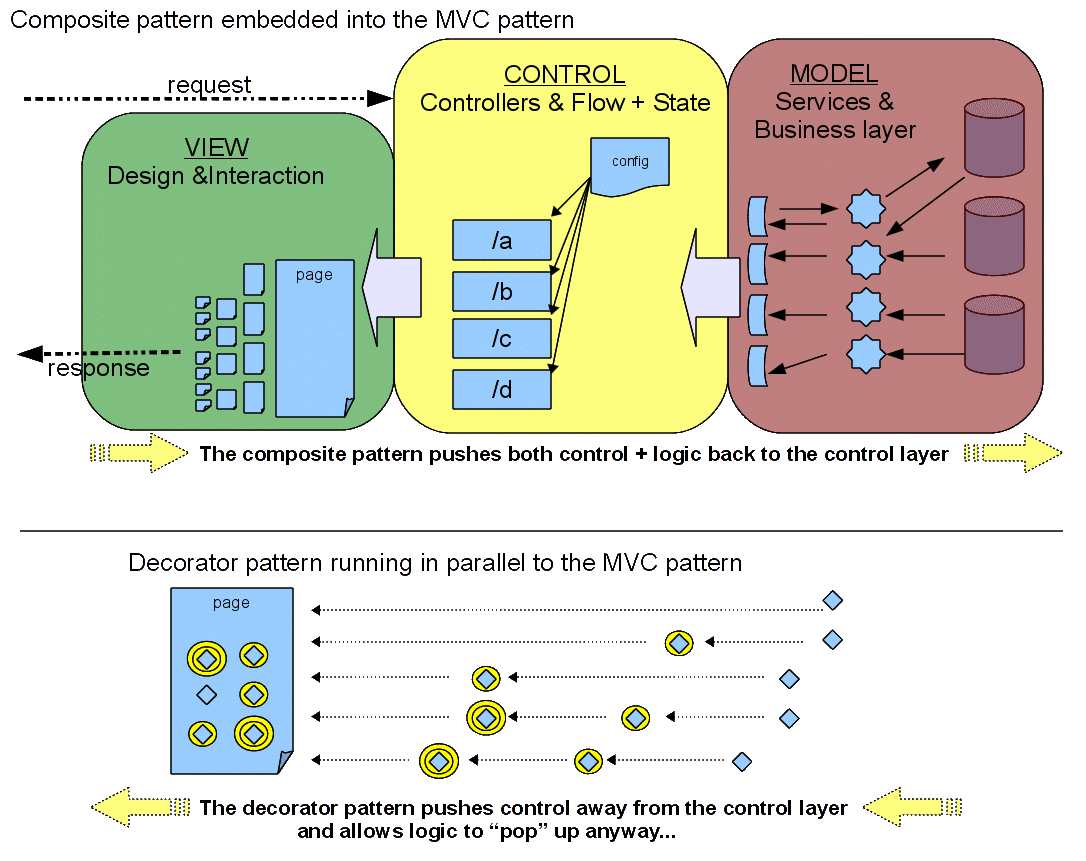
 The Decorator pattern allows front end code and design to be injected as we process. When a decision is known during the request processing the code can immediately build a decorator. The context here only holds all the built decorators. And at the end of the request lifecycle the page is assembled by putting together all these decorators. Decorators can also be built upon each other, or stacked, and this can be useful when the composition of the page is completely loose.
The Composite pattern presumes the page to be a "composite" made up from components, where each component is free to be itself a "composite". The pattern allows more control of the composite's heirarchy: as the delegation is top-down as opposed to the Decorator pattern whom's is bottom-up. The composite pattern works well when the operations you need to perform on each object is limited, that is it isn't a problem that the operations you may perform on any one object is the lowest common demominator of operations that you can perform on every object.
The Decorator pattern allows front end code and design to be injected as we process. When a decision is known during the request processing the code can immediately build a decorator. The context here only holds all the built decorators. And at the end of the request lifecycle the page is assembled by putting together all these decorators. Decorators can also be built upon each other, or stacked, and this can be useful when the composition of the page is completely loose.
The Composite pattern presumes the page to be a "composite" made up from components, where each component is free to be itself a "composite". The pattern allows more control of the composite's heirarchy: as the delegation is top-down as opposed to the Decorator pattern whom's is bottom-up. The composite pattern works well when the operations you need to perform on each object is limited, that is it isn't a problem that the operations you may perform on any one object is the lowest common demominator of operations that you can perform on every object.
Conclusion
1. Tiles-3
2. Composite pattern
3. Decorator pattern
4. Spring Web
5. Integrating Tiles and Spring
6. Initial discussion regarding Tiles definition delegation[Gone]
7. Spring 3.2 with Tiles-3 :: Tiles-3 support